
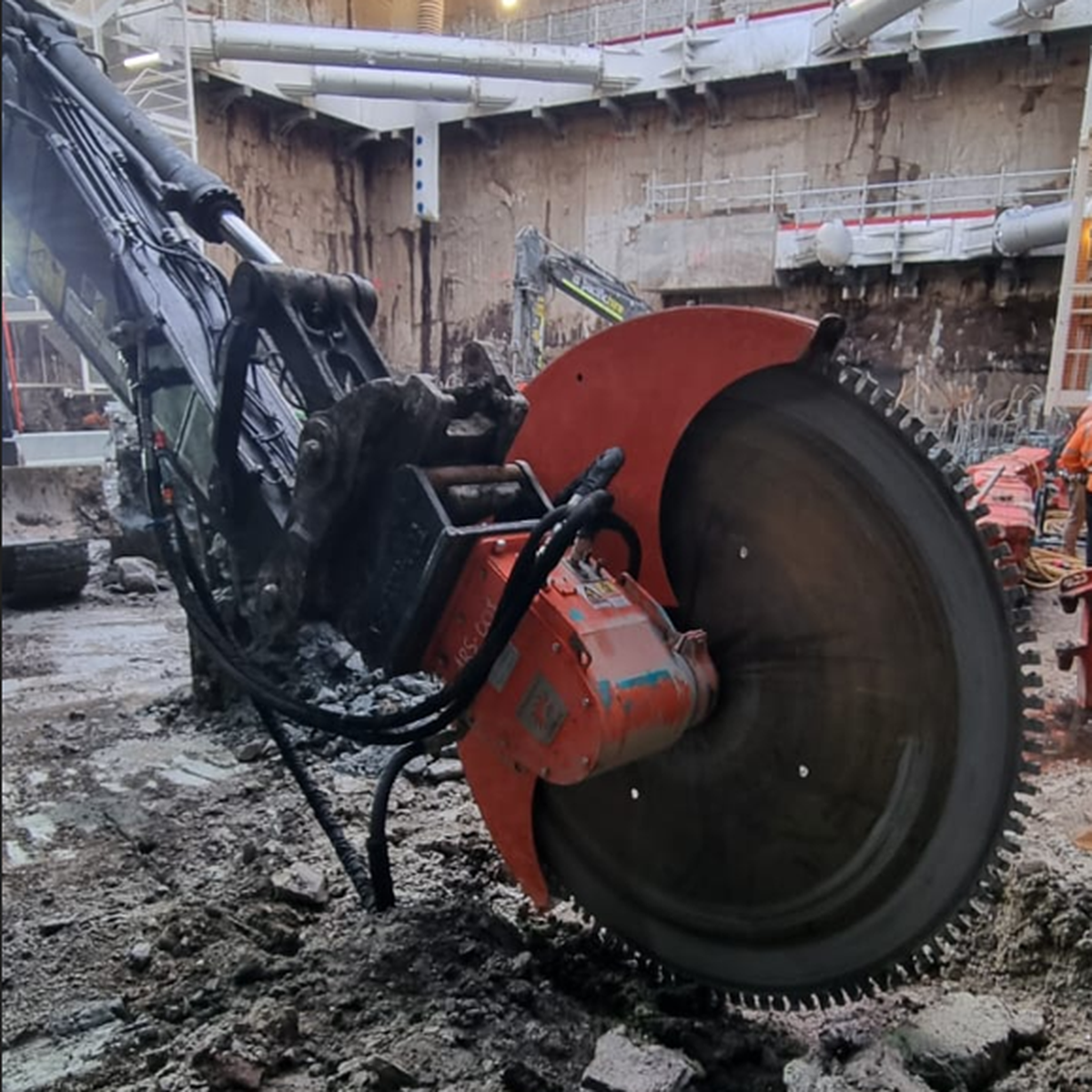
Rock Saw
An excavator-mounted circular saw defines cuts in suitable rock or concrete. Blade type and cutting method are selected for the material, cut geometry and finish; the cut material usually needs a separate removal step.
When to choose it
- Defining rock trench edges and excavation boundaries
- Separating suitable concrete sections before removal
- Cuts where depth, orientation and face finish need to follow a specified line
When it’s not the right call
- Bulk rock removal. A saw defines cuts; it does not remove the material inside them. Include the follow-up breaker, cutter or bucket method.
- Long trench runs in soil. A chain trencher or excavation method may be more suitable where the ground does not need sawing.
- Diamond cutting without water. Diamond wet cutting needs the specified water supply and slurry controls. Discuss water access or an alternative method.
Diamond or tungsten carbide?
| Blade | Diamond blade | Tungsten carbide blade |
|---|---|---|
| Material | Diamond bladeSuitable rock and concrete, matched to blade specification. | Tungsten carbide bladeSelected softer-to-medium or clay-rich ground, subject to the pick and saw rating. |
| Water | Diamond bladeSpecified water supply needed for wet cutting, with slurry management. | Tungsten carbide bladeBlade cooling may not require water; dust and silica controls still apply. |
| Finish | Diamond bladeGenerally the smoother face of the two methods. | Tungsten carbide bladeGenerally a rougher face from the cutting picks. |
| Consumables | Diamond bladeDiamond segments and blade condition need to suit the material. | Tungsten carbide bladeReplaceable picks selected for the material and wear conditions. |
| Noise and output | Diamond bladeAssess the actual material, method and site limits; no universal result. | Tungsten carbide bladeAssess the actual material, method and site limits; no universal result. |
| Choose it when | Diamond bladeThe blade suits the material, a smoother face is needed and water/slurry controls are available. | Tungsten carbide bladeThe material suits carbide picks and a rougher face is acceptable. |
In some ground either method may work. Send the geotech information, cut dimensions and site limits so the blade and removal method can be assessed.
Sizes we work with
The size depends on your machine and the job. Share the carrier make and model, material and dimensions so we can check the setup.
Using your own machine or hiring ours? Include that in your enquiry.
The Right Setup Starts Here
Tell us what you need to get done. A few key details about your job help us specify, configure and commission the right attachment for your machine, application and site requirements.
- Material: Rock type, geotech data, abrasivity and any concrete reinforcement.
- The cut: Depth, length, orientation and the face finish required.
- Site conditions: Boundaries, services, nearby structures, noise limits, water, dust and slurry controls.
- Carrier and access: Machine make/model, operating weight, hitch, reach, working platform and relevant hydraulic circuits.
Tell us about your project.
Complex scope. Tight timeline. Compliance-critical. That's where we start.
Scope your job
Common questions
What is an excavator rock saw used for?
An excavator rock saw cuts defined lines in suitable rock or concrete - trench edges, excavation boundaries and sections that need separating before removal. It gives a cleaner, more controlled edge than breaking alone. The cut material usually still needs a separate removal step, so the saw is typically planned alongside a bucket, hammer or drum cutter. On the North East Link Lower Plenty D-Walls works, a rock saw was used to cut through 4% cement-treated crushed rock up to 600mm thick and the underlying platform material during diaphragm wall construction.
Can a rock saw cut cement-treated crushed rock?
It can, when the blade is matched to the material. On the North East Link Lower Plenty D-Walls works the ground was 4% cement-treated crushed rock up to 600mm thick. A closed-tooth diamond blade allowed crushed rock to build up around the blade and stall the saw, so the package was reconfigured with tungsten-carbide pick style teeth that cut the treated material without that build-up. If your ground is cement-treated, send us the treatment percentage, layer thickness and any underlying material so the blade can be specified before mobilisation.
Should I use a diamond or tungsten-carbide blade on a rock saw?
Diamond blades generally give a smoother cut face and suit harder, more uniform material. Tungsten-carbide blades use replaceable picks and can suit selected softer-to-medium or clay-rich ground, or ground that packs a closed blade. The Lower Plenty D-Walls works are an example: the diamond configuration stalled in cement-treated crushed rock, and the tungsten-carbide pick style tooth configuration was what kept the saw cutting. Ground conditions, reinforcement and the blade's actual rating decide the choice, so send us the geotech information and the finish you need.
Does a rock saw need water when cutting?
Diamond wet cutting needs the specified water supply for blade cooling. Some carbide saws cut without blade-cooling water, but dust and respirable silica controls still need assessing for the site. Tell us what water is available and the dust requirements so we can scope the right method.
Will a rock saw fit my excavator?
Supply the excavator make, model, operating weight and hitch details, plus available hydraulic flow, pressure and auxiliary circuits for powered tools. We check the rock saw against the carrier before anything mobilises, so the setup arrives matched to the machine and the task rather than being sorted out on site. The Lower Plenty D-Walls package ran on a 25-tonne Sumitomo SH235X-6, commissioned and tested before mobilisation and inducted to North East Link requirements through ChekRite before arriving on site.